IDDSI vs. National Dysphagia Diet: What Changed, What Didn’t, and Why Your Hospital Might Still Use Either
If you have spent any time trying to understand a modified diet for someone with a swallowing disorder, you have probably run into one of the most confusing things in healthcare: two completely different terminology systems that describe essentially the same thing.
One system uses numbers. The other uses words like nectar-thick and honey-thick. Some hospitals use one, some use the other, and some use their own in-house labels that match neither. You Google “nectar-thick” and get results about IDDSI Level 2. You ask the rehab center what level your mother is on and they say “mechanical soft.” Nobody seems to be speaking the same language, and when the stakes are aspiration pneumonia, that is not a minor inconvenience.
I have been a speech-language pathologist for over twenty years. I have worked through the transition from the National Dysphagia Diet (NDD) to the IDDSI Framework, and I have watched the confusion it creates for both clinicians and families. This article is the plain-language explainer I wish existed when my own patients’ caregivers started asking me why the hospital and the rehab facility were using different words.
The Short Version
The National Dysphagia Diet (NDD) was developed in 2002 by the American Dietetic Association. It used descriptive labels for food textures (Dysphagia Pureed, Mechanically Altered, Advanced) and liquid thicknesses (Nectar-Thick, Honey-Thick, Spoon-Thick/Pudding-Thick). For over a decade, it was the standard in the United States.
The International Dysphagia Diet Standardisation Initiative (IDDSI) was developed in 2013 and finalized its framework in 2016, with widespread adoption beginning around 2019. It uses numbers (0 through 7) and includes objective testing methods (the fork drip test, the spoon tilt test, the IDDSI syringe flow test) so that the consistency can be verified, not just described.
IDDSI was designed to replace NDD and all other country-specific systems with a single global standard. And in many facilities, it has. But “designed to replace” and “has replaced” are two different things. As of right now, adoption is far from universal. Many skilled nursing facilities, home health agencies, smaller hospitals, and some large health systems still operate on NDD terminology or hybrid systems.
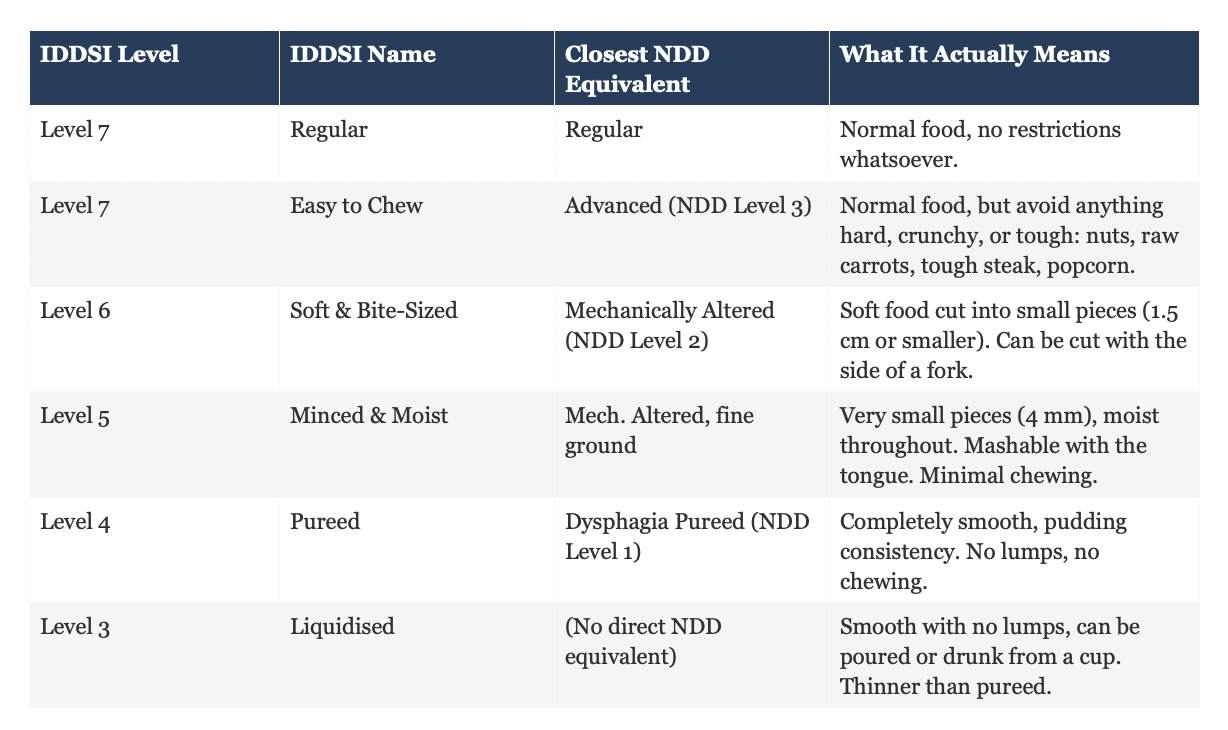
The Full Crosswalk: Food Textures
This table shows how the two systems map to each other for food. Keep in mind that the mapping is approximate — the systems were not designed to be interchangeable, and there are real differences in how they define and test each level.
The Full Crosswalk: Liquid Thickness
This is where the most confusion happens. The NDD terms (nectar, honey, pudding) are intuitive but imprecise — what one person considers “nectar-thick” may not match another’s interpretation. IDDSI replaced them with numbered levels and an objective testing method (the syringe flow test) to standardize what each thickness actually means.
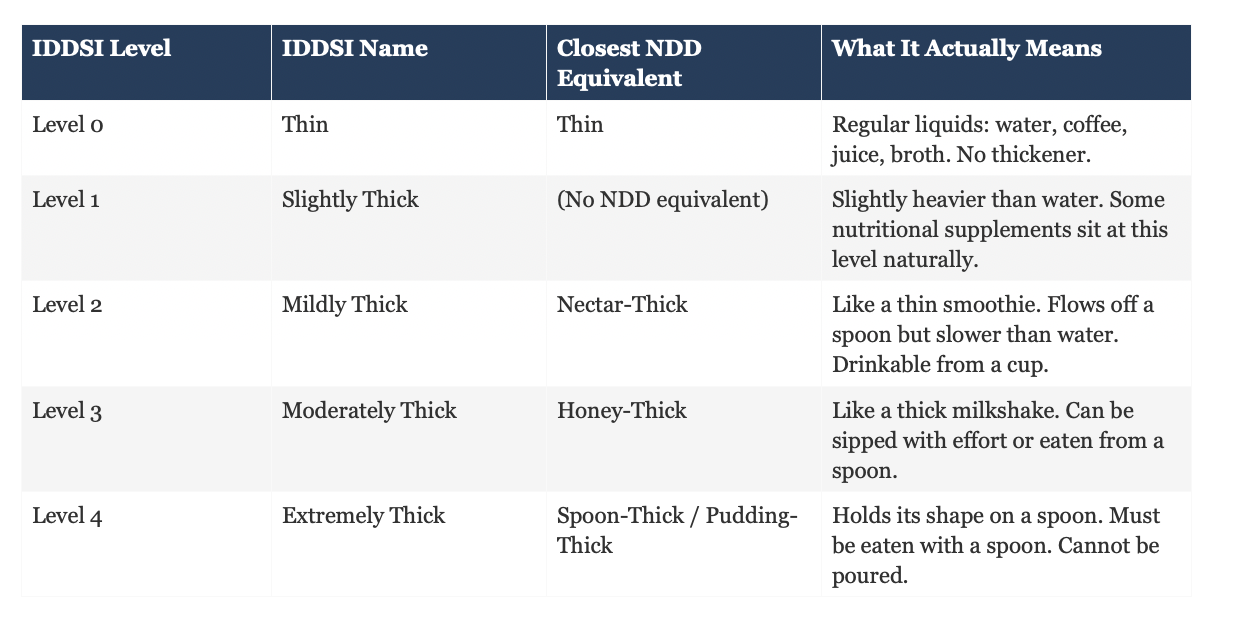
Important: These crosswalks are approximate. Research has shown that the thickener concentrations required to reach NDD levels do not always align precisely with the corresponding IDDSI levels, and the differences vary depending on the type of liquid being thickened. This is one of the reasons IDDSI introduced objective testing methods. When in doubt, the consistency demonstrated by the speech therapist always takes precedence over the label.
Why Two Systems Still Exist
If IDDSI was designed to be the global standard, why is NDD still in use?
Infrastructure and cost. Switching diet terminology in a healthcare facility is not as simple as sending a memo. It requires updating menus, retraining kitchen staff, revising electronic health records, printing new signage, educating nursing staff, and changing order sets. For large systems, this is a multi-month project with real costs.
EMR limitations. Some electronic medical record systems still have NDD terminology hard-coded into their dietary order sets. Until the system is updated, clinicians are limited to the terms available in the dropdown menu.
Familiarity. Clinicians who trained and practiced under NDD for a decade or more may default to those terms in conversation, even in facilities that have officially adopted IDDSI. “Nectar-thick” is embedded in clinical muscle memory.
Payer and regulatory lag. Some state survey processes, payer documentation requirements, and facility policies have not yet updated their language to reflect IDDSI.
The result is a transitional period that has lasted longer than anyone expected. And in the middle of it are families and caregivers who just need to know what to feed their loved one for lunch.
What This Means If You Are a Caregiver
If someone you love has a swallowing disorder and you are managing their diet at home, here is what matters:
Ask which system your facility uses. When the speech therapist prescribes a diet, ask: “Are you using IDDSI levels or the National Dysphagia Diet?” This one question prevents hours of confusion when you start Googling at home.
Get a demonstration, not just a label. No matter which system is used, ask the speech therapist to show you what the food and liquid should look and feel like. A live demonstration is always more useful than a term on a discharge paper. Ask to practice preparing a thickened liquid in front of them so they can confirm you are getting it right.
Use the crosswalk tables above. If you transfer between facilities and encounter different terminology, reference the tables in this article to find the equivalent. Level 2 is nectar-thick. Mechanically altered is Level 5 or 6. Pureed is pureed in both systems.
When in doubt, call the speech therapist. Do not guess. A phone call takes two minutes. Getting the thickness wrong can be dangerous. Every SLP I know would rather answer your question than treat an aspiration pneumonia.
What This Means If You Are an SLP
If you are still navigating the transition in your facility, or working across settings that use different systems, a few practical considerations:
Document in whatever system your facility uses, but educate in both. Your caregiver may go home, see a home health SLP from a different agency, or get readmitted to a hospital that uses the other system. If your handout says “Level 2” and the next provider says “nectar-thick,” the caregiver is confused. Providing a crosswalk reference eliminates this problem.
Use plain language first, terminology second. When you tell a caregiver “Your husband is on IDDSI Level 2, mildly thick liquids,” what they hear is noise. When you say “His drinks need to be about the thickness of a thin smoothie — that’s called mildly thick or nectar-thick depending on the system,” they have something they can actually picture.
Advocate for IDDSI adoption when possible. The objective testing methods (fork drip test, spoon tilt test, syringe flow test) are a genuine clinical improvement over the subjective NDD descriptions. If your facility has not transitioned, it is worth raising with your department leadership. The resources at iddsi.org are comprehensive and free.
Include the crosswalk in your caregiver education materials. This is one of the single most useful pages you can give a family at discharge. When they search “what is nectar-thick” at 10 PM, they will find 47 conflicting results. If they have your crosswalk chart on the refrigerator, they have the answer.
The IDDSI Testing Methods: A Quick Reference
One of the most practical improvements IDDSI introduced is objective testing. Instead of relying on subjective descriptions (“honey-like” means different things to different people), IDDSI provides physical tests anyone can perform:
The Fork Drip Test (for liquids): Hold a fork horizontally and let the liquid drip through the prongs. Thin liquids drip through freely. Mildly thick liquids drip through in a steady stream. Moderately thick liquids may drip slowly or sit above the prongs. Extremely thick liquids sit on the fork without dripping.
The Fork Pressure Test (for foods): Press the flat side of a fork against the food. If the food squashes through the prongs and does not return to its original shape, it is soft enough for Levels 4 through 6 (depending on how small the pieces are).
The Spoon Tilt Test (for pureed foods): Scoop the food onto a spoon and tilt it to the side. Pureed food (Level 4) should slide off in a single mass. It should not pour like a liquid and should not stick to the spoon like a solid.
The Syringe Flow Test (for liquids, clinical use): A 10 mL syringe is filled with the liquid and allowed to flow for 10 seconds. The amount of liquid remaining in the syringe determines the IDDSI level. This is the most precise test and is used in clinical and research settings.
Caregivers do not need to use the syringe test. The fork drip test and spoon tilt test are simple enough to do at the kitchen counter, and they give you a reliable way to verify that the food or liquid you prepared is actually the right consistency.
Resources
For Caregivers
If you are caring for someone with a swallowing disorder and want a complete guide that covers diet textures, safe feeding techniques, aspiration warning signs, oral care, and how to navigate the terminology confusion between facilities — all written in plain language by a clinician with over 20 years of experience — I created one:
The Swallowing Safety Guide for Families includes a full IDDSI-to-NDD crosswalk chart, a tear-out refrigerator reference card, and a list of questions to bring to your next appointment.
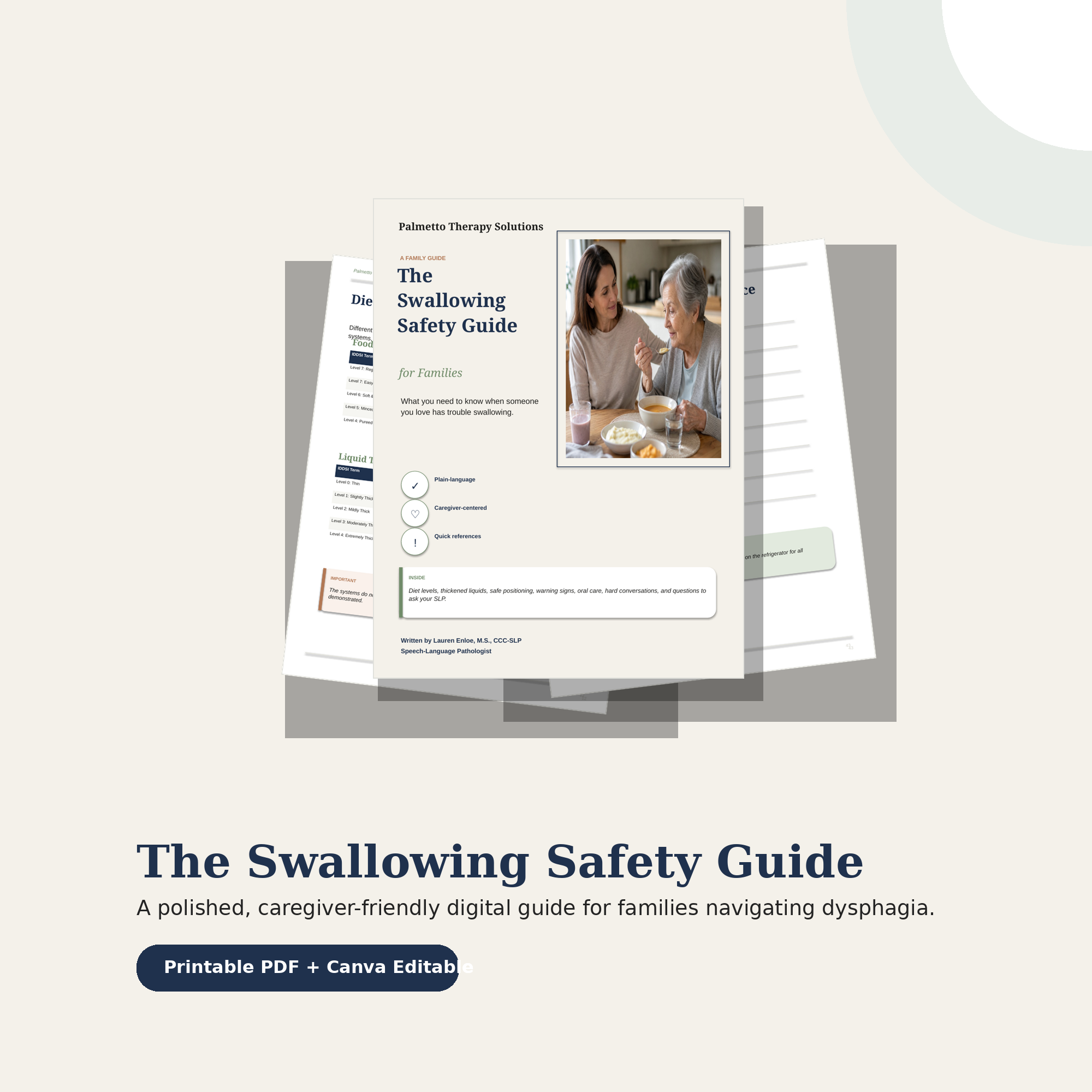
What you need to know when someone you love is having trouble swallowing.
When someone you love is diagnosed with dysphagia, the discharge instructions can feel overwhelming. Suddenly you are hearing words like aspiration, pureed diet, nectar-thick liquids, IDDSI levels, and swallowing strategies - and you are expected to know what to do at home.
The Swallowing Safety Guide for Families was created by Lauren Enloe, M.S., CCC-SLP, to give caregivers clear, practical information in a format they can actually use. It explains what dysphagia means, why aspiration matters, how diet textures and thickened liquids work, how to set up safer meals, what warning signs to watch for, and how to have the hard conversations around food changes.
If you want a free starting point, download the one-page Signs of Aspiration quick-reference card — the warning signs to watch for, what to do, and who to call.
hen someone you love has trouble swallowing, mealtimes can feel stressful fast. You may be trying to remember diet levels, liquid thickness, swallowing strategies, warning signs, and who to call — all while simply trying to help them eat safely.
This one-page Swallowing Safety Quick Reference was created to give families and caregivers a clear, easy-to-use reminder they can print and place on the refrigerator.
Inside, you’ll find space to record your loved one’s:
Current food texture level
Current liquid thickness
Special swallowing strategies
Speech therapist’s name and phone number
Doctor’s name and phone number
It also includes simple, plain-language reminders for when to stop the meal and when to call 911.
This quick reference is not meant to replace individualized medical advice, but it can help keep important swallowing safety information visible for everyone involved in your loved one’s care.
Download it, print it, fill it out with your speech therapist, and place it somewhere easy to see.
Because when swallowing safety matters, caregivers need clear information close at hand.
For SLPs
If you are looking for structured caregiver education materials that include both IDDSI and NDD terminology, with documentation templates mapped to the new G0541/G0542 billing codes, I built a complete toolkit for that:
The Caregiver Dysphagia Education System includes seven modules of print-ready handouts and clinical documentation tools, with the crosswalk built into every caregiver-facing piece so your families can navigate across facilities and terminology systems.
Still unsure? Let’s chat!

Unsure of where to begin and need to ask questions?
Are you a SLP that just needs someone to bounce ideas off of?
