Your Family Member Was Just Diagnosed with a Swallowing Problem. Now What?

Nobody prepares you for this conversation. You are sitting in a hospital room or a rehab center, and a therapist you have never met is telling you that your mother — the woman who made Sunday pot roast every week for 40 years — can no longer eat regular food.
She has something called dysphagia. A swallowing disorder. And now there are words being thrown around that you have never heard before: pureed diet, nectar-thick, IDDSI levels, aspiration risk. You nod like you understand, but inside you are thinking: what am I supposed to do with this when I get her home?
I am a speech-language pathologist. I have been treating swallowing disorders for over two decades. And I have sat across from hundreds of family members who looked exactly like you do right now — overwhelmed, scared, and trying to absorb information while the world tilts sideways.
Here is what I want you to know:
First: Take a Breath
Dysphagia is serious, but it is manageable. People live with swallowing problems every day, and with the right guidance, you can help your loved one eat safely at home. You do not need a medical degree. You need clear information and a plan.
That is what this article is for. I am going to walk you through the basics: what is actually happening when someone cannot swallow safely, what the diet recommendations mean, and what you need to watch for once you get home.
What Is Actually Happening
Swallowing involves more than 30 muscles working together in a sequence that takes about three seconds. When a stroke, Parkinson’s disease, a brain injury, head and neck cancer, or even normal aging disrupts that sequence, food or liquid can go into the airway instead of the stomach.
This is called aspiration. It is the main danger of dysphagia, because food and liquid that enter the lungs can cause a serious infection called aspiration pneumonia. This is especially dangerous in older adults.
The speech therapist evaluated your loved one’s swallowing and made diet recommendations to reduce that risk. Those recommendations are not punishments. They are the safest path forward.
Understanding the Diet: What Those Terms Actually Mean
One of the most confusing things for families is the terminology. Depending on the facility, you might hear IDDSI levels (an international numbering system) or National Dysphagia Diet terms (like nectar-thick and honey-thick). Some facilities use their own labels entirely.
Here is a simplified breakdown of what the most common diet levels mean in practical terms:
Pureed: Completely smooth, like pudding. No lumps, no pieces, no chewing required. Think applesauce, smooth mashed potatoes, pureed soups that have been blended until there is nothing visible.
Minced and moist: Very small pieces, about the size of a grain of rice, and wet throughout. Your loved one should be able to mash it with their tongue.
Soft and bite-sized: Soft enough to cut with the side of a fork. Pieces about the size of your thumbnail. Tender meat, cooked vegetables, soft pasta.
Easy to chew: Regular food, but avoiding anything hard, crunchy, or tough. No raw carrots, nuts, popcorn, or tough steak.
For liquids, your loved one’s speech therapist may recommend thickened liquids. This slows the liquid down so the swallowing muscles have more time to protect the airway. You might hear terms like nectar-thick (drinkable from a cup, like a thin smoothie) or honey-thick (sippable with effort, like a thick milkshake). Commercial thickeners are available at most pharmacies.
Practical tip: If you are confused by the terminology, ask the speech therapist to show you what the food and liquid should look and feel like. Demonstrations are always more useful than labels.
Three Things You Can Do Today
1. Learn the warning signs
The most important thing you can take home from this article is knowing what aspiration looks like — and what it does not look like.
Signs you may see during meals: coughing or choking while eating, a wet or gurgly voice right after swallowing, watery eyes, repeated throat clearing, food coming out of the nose, or difficulty starting a swallow.
Signs of silent aspiration (no cough, no obvious signal): recurring pneumonia, unexplained fevers, chronic chest congestion, or unintended weight loss over time. Silent aspiration is the most dangerous form precisely because you cannot see it happening in the moment.
2. Set up the eating environment
Position your loved one upright — as close to 90 degrees as possible — for all meals, and keep them upright for 30 minutes afterward. Turn off the television. Serve meals when they are most alert (usually morning and midday, not late evening when fatigue sets in). Use a teaspoon-sized bite and wait for the swallow before offering the next one. Do not rush.
3. Take care of their mouth
This one surprises most families. Oral hygiene is one of the strongest predictors of whether aspiration leads to pneumonia. Brush teeth twice a day, brush the tongue, use alcohol-free mouthwash. Even if your loved one is not eating by mouth, the mouth still needs to be cleaned every few hours. A cleaner mouth means fewer bacteria, and fewer bacteria means a lower risk of infection if aspiration does occur.
The Part Nobody Talks About
Here is what the hospital discharge paperwork does not cover: the grief.
When someone loses the ability to eat the foods they love, it is a loss. Food is tied to identity, culture, holidays, family, comfort. Your mother is not just losing pot roast. She is losing a piece of how she sees herself. That deserves to be acknowledged — by you, and by the people treating her.
And you are going to grieve it too. You are going to stand in the kitchen trying to figure out how to make pureed food that does not look and taste like baby food, and you are going to feel angry and sad and overwhelmed. That is normal. That is not weakness. That is love showing up in an ugly situation.
Give yourself permission to feel that, and then keep going.
What to Do Next
If you want a more complete guide that walks you through everything — diet textures explained with both IDDSI and NDD terminology, safe feeding positioning for every setting, the full list of warning signs with a decision guide for when to call the therapist versus when to call 911, oral care protocols, how to have the hard conversations about diet changes, and a tear-out quick-reference card you can put on the refrigerator — I wrote one.
The Swallowing Safety Guide for Families is a digital guide I created after twenty years of watching families leave hospitals with too little information and too much fear. It is written in plain language, it covers both terminology systems so you will understand your loved one’s diet no matter which hospital they came from, and it is designed to sit on your kitchen counter and actually get used.
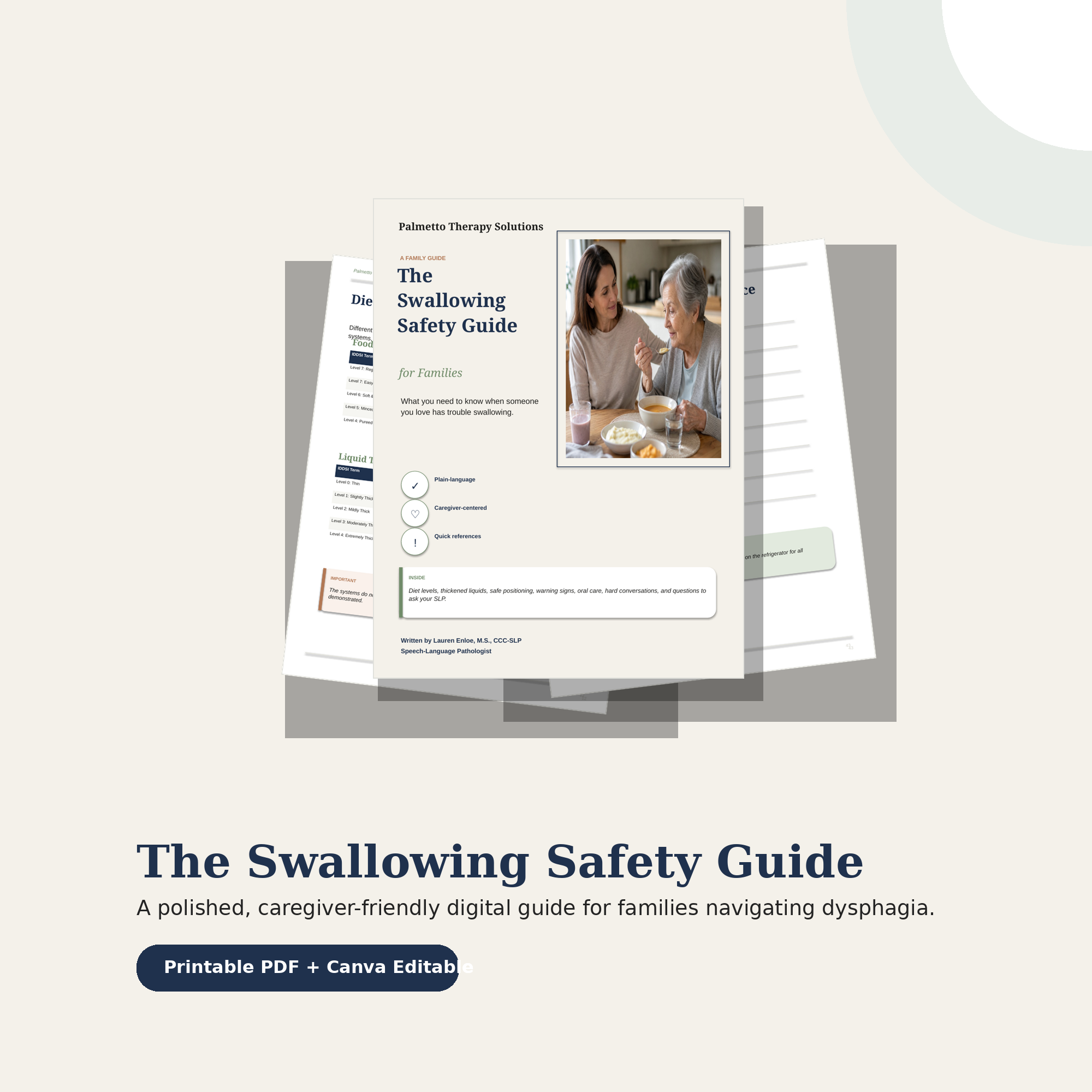
What you need to know when someone you love is having trouble swallowing.
When someone you love is diagnosed with dysphagia, the discharge instructions can feel overwhelming. Suddenly you are hearing words like aspiration, pureed diet, nectar-thick liquids, IDDSI levels, and swallowing strategies - and you are expected to know what to do at home.
The Swallowing Safety Guide for Families was created by Lauren Enloe, M.S., CCC-SLP, to give caregivers clear, practical information in a format they can actually use. It explains what dysphagia means, why aspiration matters, how diet textures and thickened liquids work, how to set up safer meals, what warning signs to watch for, and how to have the hard conversations around food changes.
If you are not ready for that but want a free starting point, I have a one-page Signs of Aspiration quick-reference card you can download and print right now. It covers the warning signs, what to do, and who to call. Put it on the fridge. It might be the most important piece of paper in your kitchen.
hen someone you love has trouble swallowing, mealtimes can feel stressful fast. You may be trying to remember diet levels, liquid thickness, swallowing strategies, warning signs, and who to call — all while simply trying to help them eat safely.
This one-page Swallowing Safety Quick Reference was created to give families and caregivers a clear, easy-to-use reminder they can print and place on the refrigerator.
Inside, you’ll find space to record your loved one’s:
Current food texture level
Current liquid thickness
Special swallowing strategies
Speech therapist’s name and phone number
Doctor’s name and phone number
It also includes simple, plain-language reminders for when to stop the meal and when to call 911.
This quick reference is not meant to replace individualized medical advice, but it can help keep important swallowing safety information visible for everyone involved in your loved one’s care.
Download it, print it, fill it out with your speech therapist, and place it somewhere easy to see.
Because when swallowing safety matters, caregivers need clear information close at hand.
